
Water Softeners and Water Treatment in Las Vegas, NV
At about 16 grains per gallon, Las Vegas water is hard enough to scale up fixtures and water heaters quickly. We install, repair and maintain softeners and salt-free conditioners.
- 24/7 emergency service
- Licensed technicians
- All makes and models
What very hard Las Vegas water does in a home
The Las Vegas Valley Water District reports water hardness of about 280 parts per million, or 16 grains per gallon. On the usual scale that is very hard. The minerals involved, mostly calcium and magnesium, come out of solution as scale wherever water is heated or left to dry.
You will recognize the results:
- White crust on faucets, showerheads and around drains.
- Spots on glassware and a film on shower doors.
- Soap and shampoo that lather poorly, and laundry that feels stiff.
- Faucet aerators and showerheads that clog and lose flow.
- A water heater that rumbles or pops as it heats, a sign of scale on the bottom of the tank.
Scale inside a water heater sits between the burner or element and the water, so the heater works harder and wears sooner. Treating the water where it enters the house protects everything downstream.
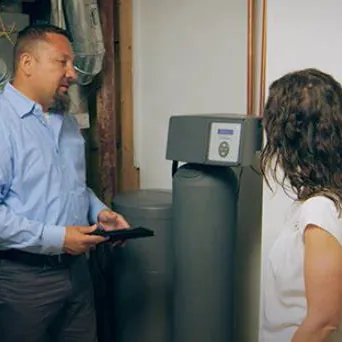
How a water softener works
A softener removes hardness by ion exchange. Water flows through a tank of resin beads that carry sodium. Calcium and magnesium cling to the beads, and sodium is released into the water in their place. The water leaving the tank is soft.
The resin can only hold so much. When it is loaded, the control valve runs a regeneration cycle, usually in the middle of the night. Salty water from the brine tank washes through the resin, strips off the hardness and carries it to a drain, and the resin is ready again. A metered valve regenerates according to the gallons you actually use, which saves salt and water compared with a simple timer.
Installation needs a place on the main line, a drain and a power outlet. In a lot of valley garages the builder left a loop of pipe for exactly this purpose. We size the unit to your household and the hardness, and normally leave outdoor hose bibs and irrigation on untreated water. Softening adds some sodium to the water. If you would prefer not to drink it, potassium chloride can be used in place of salt, or a reverse osmosis tap can go in at the kitchen sink.
Salt-free conditioners: scale reduction, not softening
Conditioners that use no salt are often sold as softeners. They are not, and it is better to know that before you buy one. The common type uses a media that makes hardness minerals form tiny crystals, which stay suspended in the water and are less likely to stick to pipes and heating surfaces. The minerals are still there. A hardness test reads the same before and after, soap lathers no better, and spots still form where water dries on glass.
What a good conditioner can do is cut down the hard scale that builds inside pipes and water heaters. It needs no salt, no drain and no electricity, and upkeep is mostly a matter of replacing the media every few years on the maker's schedule. Results vary with water chemistry, and with water as hard as ours a conditioner will not match a softener. Be more cautious still about magnetic or electronic devices that clamp onto a pipe. Independent test results on those are mixed.

Salt, upkeep and repairs
Softeners need a little regular attention from the owner:
- Check the brine tank about once a month and keep the salt above the water line.
- Use clean pellet or crystal salt made for softeners.
- If the salt level stops dropping, a hard crust called a salt bridge may have formed above the water. Break it up gently with a broom handle.
- Empty and rinse the brine tank when sludge collects at the bottom.
Call us if hard water signs return, the brine tank fills with water, the unit runs to the drain without stopping or the water tastes salty. Typical repairs include cleaning a blocked injector, replacing worn valve seals, fixing the brine float or line, and reprogramming a valve that lost its settings. Resin often lasts ten years or more, though chlorine in city water slowly breaks it down, and a carbon filter ahead of the softener helps. We service all makes and models and can refill a tank with new resin when the rest of the unit is sound.
Choosing and installing the right system
We begin by testing your water at the tap and looking at the plumbing where the line comes in. From there a licensed plumber gives you a straight recommendation on softener or conditioner, and on size, based on how many people live in the house and how much water you use. A new system can be paid for with financing, subject to approved credit. To set up a visit anywhere in Las Vegas or the nearby Clark County communities, call 702-497-0888.
Frequently asked questions
Still have a question? Call 702-497-0888.
How hard is the water in Las Vegas?
Very hard. The Las Vegas Valley Water District reports about 280 parts per million, which is 16 grains per gallon. Water is generally classed as very hard above roughly 10.5 grains per gallon, so local water is well past that mark. That is why scale shows up so quickly on fixtures and inside water heaters here.
How much salt does a water softener use?
It depends on your water use, the hardness and how efficient the softener is. With water this hard, a family of four often goes through about one 40-pound bag a month, and a larger household uses more. A metered softener that regenerates only when needed uses noticeably less salt than an older timer model.
Does softened water taste salty?
No, properly softened water should not taste salty. The softener adds sodium in proportion to the hardness it removes, which is different from adding table salt. If the water does taste salty, the unit is probably not rinsing fully after regeneration, often because of a blocked drain line or injector, and it needs service.
Do salt-free water conditioners really work?
They can reduce scale buildup inside pipes and water heaters, but they do not soften water. Hardness minerals stay in the water, so you will still see spots, and soap will lather as it did before. If scale protection with no salt and little upkeep is your goal, a conditioner may suit you. If you want soft water, you need a softener.
How long does a water softener last?
A well-kept softener often lasts ten to fifteen years. The control valve and the resin are the parts that wear, and both can frequently be repaired or replaced without changing the whole unit. Very hard water and chlorine shorten resin life, so regular salt checks and a carbon prefilter help.
Related plumbing services
Schedule service
Tell us what is going on and we will call you back to set a time. For anything urgent, the phone is fastest.
702-497-0888- 24/7 emergency service
- 3200 Kings Way, Las Vegas, NV 89102
View in Google Maps