
Smart and Wi-Fi Thermostat Installation in Las Vegas
The thermostat tells your heating and cooling system when to run. We install and set up programmable, Wi-Fi and smart thermostats, and sort out the wiring and compatibility questions that come with them.
- 24/7 emergency service
- Licensed technicians
- All makes and models
Programmable, Wi-Fi and smart thermostats compared
All thermostats do the same basic job: they read the room temperature and switch the equipment on and off. The differences are in how much of the scheduling they do for you.
- Manual. Holds one temperature until you change it.
- Programmable. Follows a schedule you set by time of day and day of the week.
- Wi-Fi. A programmable thermostat you can also control from a phone app, with alerts if the house gets too hot or too cold.
- Smart. Adds features such as learning your routine, sensing when the house is empty, remote room sensors, energy reports and filter reminders.
The saving comes from running the system less when nobody needs it, not from the device itself. If your routine is steady and you will actually set a schedule, a plain programmable model does most of the work. Smart features earn their place when your hours are irregular, when you travel, or when you want to keep an eye on a rental or second home.
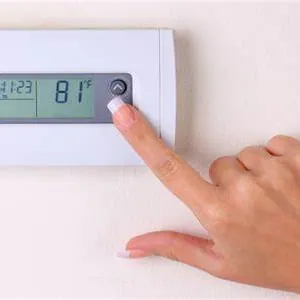
Compatibility, wiring and the C-wire
Most central systems use low-voltage control wiring, a thin cable with several colored conductors running from the thermostat to the furnace or air handler. Wi-Fi and smart thermostats need steady power, which comes from the common wire, or C-wire. Many older installations do not have one connected. The usual fixes are to use a spare conductor already in the cable, run a new cable, or fit a power adapter at the equipment. Thermostats that try to get by without a C-wire can cause odd behavior such as short cycling or a screen that keeps restarting.
Equipment type matters too. A heat pump needs a thermostat that controls the reversing valve and auxiliary heat, and a wrong setting there can give you heat when you ask for cooling. Two-stage and variable-speed systems may need a matching control to use all their stages. Ductless mini-splits use their own controllers, and electric baseboard heat runs on line voltage, which a low-voltage thermostat cannot switch.
Where the thermostat should go
A thermostat only knows the temperature at the spot where it hangs. The usual location is an interior wall about five feet off the floor, in a room you use, where air moves past it freely. These places give false readings:
- In direct sun, or on a wall that backs onto the garage or outdoors
- Near a supply register, kitchen, fireplace or exterior door
- Above a lamp, television or other electronics
- In a closed-off hallway, or behind a door or furniture
The hole behind the thermostat matters as well. If it is open to the wall cavity, drafts from inside the wall can reach the sensor and throw off the reading, so we seal it. In two-story homes the upstairs often runs warmer than the thermostat downstairs reports; remote sensors or a zoning setup can help with that.
Thermostat settings for a Las Vegas summer
With afternoon highs above 100°F for months, the schedule you choose affects both comfort and the bill.
- Raise the setting a few degrees while you are out instead of switching the system off. A house left to heat up all day takes hours to pull back down in the hottest part of the afternoon.
- Leave the fan on Auto. Running it constantly uses more electricity and, with ducts in a hot attic, can carry heat into the house between cooling cycles.
- If you are on a time-of-use electric rate, a schedule can cool the house ahead of the peak period.
- Replace the batteries once a year if your thermostat uses them.
A blank screen is not always a dead thermostat. Check the batteries and the breaker first. On many systems a safety switch on the condensate drain cuts power when the drain backs up, and that calls for AC repair, not a new thermostat.
Having us install or troubleshoot a thermostat
We start by identifying your equipment and checking the wiring at both ends, so the thermostat you pick will work with it. Then we mount it, configure it for your system type and number of stages, connect it to your Wi-Fi and walk you through the app and the schedule. If the system is misbehaving, we test whether the fault is in the thermostat or in the equipment before replacing anything. We can also check which utility rebates currently apply. Call 702-497-0888 to book.
Frequently asked questions
Still have a question? Call 702-497-0888.
Will a smart thermostat work with my heating and cooling system?
Most smart thermostats work with standard low-voltage central systems, including furnaces, air conditioners and heat pumps. The usual obstacles are a missing C-wire, proprietary controls on some variable-speed equipment, and line-voltage heaters. Check the wires connected to your current thermostat and the equipment model, or have us look, before you buy one.
What is a C-wire, and do I need one?
The C-wire, or common wire, completes the low-voltage circuit so the thermostat gets continuous power. Battery-only programmable thermostats do not need it, but most Wi-Fi and smart models do, because the display and radio draw power all the time. If your cable has an unused conductor, it can often be connected as a C-wire at both ends without running anything new.
Can I install a thermostat myself?
Many homeowners can swap a like-for-like thermostat on a simple system. Turn the power off at the breaker first, photograph the existing wiring and label each wire before disconnecting it. Letting bare wires touch with the power on can blow the low-voltage fuse or damage the transformer. Heat pumps, multi-stage equipment and anything needing a new C-wire are better left to a technician.
Why is my thermostat screen blank?
The most common causes are dead batteries, a tripped breaker, a blown low-voltage fuse at the furnace or air handler, or a condensate safety switch that has shut the system down. Replace the batteries and check the breaker. If the screen stays blank, or goes blank again in summer, there may be a clogged drain line or a wiring fault that needs a service call.
Does a smart thermostat lower the electric bill?
It can, but only by reducing how long your system runs. A thermostat that raises the setting while the house is empty will use less energy than one held at the same temperature all day. How much you save depends on your schedule, your home and the settings you choose, so we do not quote a figure. A schedule you override every day saves little.
Schedule service
Tell us what is going on and we will call you back to set a time. For anything urgent, the phone is fastest.
702-497-0888- 24/7 emergency service
- 3200 Kings Way, Las Vegas, NV 89102
View in Google Maps