
Boiler Repair, Installation and Service in Las Vegas, NV
Boilers are uncommon in Las Vegas homes, and the ones here still need skilled attention. We install, repair and maintain hot water boilers for houses, multi-unit buildings and businesses.
- 24/7 emergency service
- Licensed technicians
- All makes and models
Boilers in Las Vegas: where you find them
A boiler heats water, and a pump circulates it through radiators, baseboard convectors or tubing in the floor. Despite the name, most residential boilers never boil anything. They deliver hot water around a sealed, pressurized loop.
In a city built around ducted air conditioning, boilers are the exception. We see them in custom homes with radiant floor heating and in commercial and multi-unit buildings where one plant heats many spaces. Some homes use a combination boiler, which provides space heating and domestic hot water from a single wall-hung unit. If you are deciding how to heat a house that already has ducts, a furnace or heat pump is usually the more practical route. A boiler makes sense when you have, or want, hydronic heat.
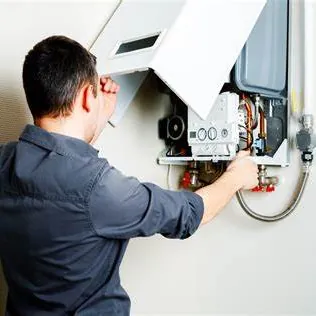
Signs a boiler needs repair
Boilers are durable, and they give clear signals when something is wrong:
- No heat or lukewarm radiators. Possible causes include ignition failure, a dead circulator pump, a stuck zone valve or a thermostat fault.
- Rumbling or banging, often called kettling. Mineral scale on the heat exchanger creates hot spots where water flashes to steam. Hard water makes this more likely here.
- Pressure out of range. Most home systems sit around 12 to 15 psi when cold and rise somewhat when hot. A gauge near zero suggests a leak or a failed fill valve. One that climbs toward 30 most often points to a waterlogged expansion tank.
- Water dripping from the relief valve pipe. The valve is doing its job. Have the cause of the high pressure found, and never cap or plug that pipe.
- Radiators hot at the bottom and cold at the top. Air is trapped and needs bleeding.
- Soot, a yellow flame or an exhaust smell. Shut the boiler off and call.
Gas boilers carry the same risks as any gas appliance. Keep carbon monoxide alarms on every level and near bedrooms, and if one sounds, go outside and call 911. If you smell gas, leave the building, call the gas utility or 911 from outside, and call us for the repair once the site is safe. Boiler water and piping are hot enough to scald, so let the system cool before touching valves.
Replacing or installing a boiler
A cast-iron boiler can run for a very long time if it is looked after, so replacement is usually prompted by a leaking heat exchanger, repeated failures, parts that can no longer be had, or fuel use that has stopped making sense. The new boiler should be sized from a heat-loss calculation of the building, not from the label on the old one, which was often oversized to begin with. An oversized boiler short cycles, wasting fuel and wearing parts.
The main choice is between conventional and condensing models. A condensing boiler extracts more heat by cooling the exhaust until its moisture condenses, which works best when the water returning to the boiler is fairly cool. That suits radiant floors well and high-temperature baseboard less well. Condensing models need a condensate drain, venting rated for them and yearly cleaning. Conventional boilers are simpler and less sensitive to water quality, at lower efficiency. With combination units our hard water is a factor: the domestic hot water side collects scale and needs periodic descaling, much as a tankless water heater does.
Annual boiler maintenance
One service visit a year, before heating season, keeps a boiler safe and efficient. Ours covers:
- Cleaning the burner and heat exchanger and checking the flame
- Combustion testing, including carbon monoxide in the flue gas
- Inspecting the vent or flue for corrosion, blockage and loose joints
- Checking system pressure and the air charge in the expansion tank
- Checking the pressure relief valve and the low-water cutoff, where one is fitted
- Operating circulators and zone valves and purging air
- Clearing the condensate trap and drain on condensing models
What you can do: glance at the pressure gauge every few weeks in winter, keep stored items away from the boiler, and watch for drips or green and white crust on fittings. Do not keep adding water to a system that loses pressure. Fresh water brings fresh minerals and oxygen, which cause scale and corrosion inside. Have the leak found instead.
Boiler help when you need it
A boiler that quits on a cold night or leaks onto the floor cannot wait, and we answer emergency calls 24/7 for homes and businesses. For everything else, call 702-497-0888 to book a repair, a yearly service or a replacement assessment. A licensed technician tests the system, explains what is wrong in plain terms and gives you options. We work on all makes and models, and for property managers we can plan maintenance around tenants and business hours.
Frequently asked questions
Still have a question? Call 702-497-0888.
What pressure should my boiler gauge show?
Most residential hot water boilers in one- or two-story homes read about 12 to 15 psi when cold and somewhat higher when hot. The relief valve is commonly set to open at 30 psi. A reading near zero, or one approaching 30 when hot, means something is wrong, usually a leak, the fill valve or the expansion tank.
Why is my boiler making banging or rumbling noises?
The most common cause is kettling, where mineral scale on the heat exchanger creates hot spots and small pockets of steam. Las Vegas water is very hard, so scale forms readily in any system that takes on fresh water often. Trapped air and a failing circulator can also make noise. Have it checked, since overheating shortens the life of the heat exchanger.
How long does a boiler last?
Cast-iron boilers commonly run 20 to 30 years or more with regular service. Condensing and wall-hung models typically last around 15 to 20 years and depend more heavily on annual cleaning and good water quality. Condition counts more than age: a leaking heat exchanger or unobtainable parts can end a boiler's life early.
Is a boiler a good way to heat a house in Las Vegas?
It is a good choice if the house already has radiant floors, radiators or baseboard, or if you are building with radiant heat in mind. For a typical valley home with ducts and central air, a furnace or heat pump is generally simpler to install and uses the ductwork you already have. We will give you a straight comparison for your house.
Can I bleed my radiators myself?
Yes, on most systems. Turn the heat off, let the radiators cool, then open the bleed valve at the top with a radiator key until water follows the air, and close it. Check the boiler pressure afterward, because releasing air lowers it. If radiators need bleeding again and again, air is getting into the system and the cause should be found.
Schedule service
Tell us what is going on and we will call you back to set a time. For anything urgent, the phone is fastest.
702-497-0888- 24/7 emergency service
- 3200 Kings Way, Las Vegas, NV 89102
View in Google Maps