
Home Water Filtration Systems in Las Vegas, NV
Las Vegas tap water meets drinking-water standards, but plenty of people dislike the chlorine taste and the minerals. We install and service whole-house filters and under-sink reverse osmosis.
- 24/7 emergency service
- Licensed technicians
- All makes and models
What a water filter does, and what it does not
Las Vegas tap water meets federal and state drinking-water standards, and your water provider publishes a water quality report every year. Filtration here is a matter of preference and of protecting fixtures and appliances. Most of the valley's supply comes from the Colorado River by way of Lake Mead. It arrives carrying a lot of dissolved minerals and a trace of the chlorine used to keep it disinfected in the pipes.
People usually call us about filtration for one of these reasons:
- A chlorine taste or smell at the tap or in the shower.
- Grit or fine sediment that clogs aerators and appliance inlet screens.
- Cloudy ice, or a mineral taste in drinking water and coffee.
- Wanting better-tasting drinking water at the kitchen sink without buying bottles.
One point to settle early: sediment and carbon filters do not remove hardness. If white scale and spotting are your main complaint, that is a job for a softener or conditioner, covered on our water treatment page.

Whole-house filters and under-sink reverse osmosis
Whole-house systems treat all the water entering the home. Point-of-use systems treat a single tap. The main types:
- Sediment filters. A cartridge or screen on the main line that traps sand, rust and flakes of scale. It protects valves, faucet cartridges and appliances, and it keeps finer filters downstream from clogging early.
- Carbon filters. Activated carbon adsorbs chlorine and many of the compounds behind off tastes and odors. Whole-house versions are either large cartridges or a tank of carbon with a valve that backwashes it.
- Reverse osmosis. An under-sink system that pushes water through a very fine membrane, reducing the dissolved minerals other filters let through. It normally has sediment and carbon stages ahead of the membrane, a small storage tank and its own faucet, and it can feed the refrigerator and ice maker.
The choice comes down to what bothers you and where. Chlorine in the shower calls for whole-house carbon. Taste at the kitchen sink calls for reverse osmosis. Many households use both.
Installation, replacement and repair
A whole-house filter goes on the main line after the shut-off valve and pressure regulator, usually in the garage. Many newer valley homes have a plumbing loop there, left by the builder for water treatment equipment, which simplifies the work. We size the system to your home's flow rate so pressure does not drop when two showers run, and we fit a bypass so the filter can be serviced without shutting off the house. If the incoming pipe or its valves are in poor shape, we will point that out, and we handle main water line work too.
A reverse osmosis unit needs a cold water connection, a drain connection and a hole in the sink or countertop for its faucet.
We also service existing systems of any make. Common faults are leaks at filter housings, low pressure from an overdue cartridge, and a reverse osmosis unit that fills slowly or drains constantly. When the media is spent, a housing is cracked or parts are no longer made, replacement is usually the sensible route.
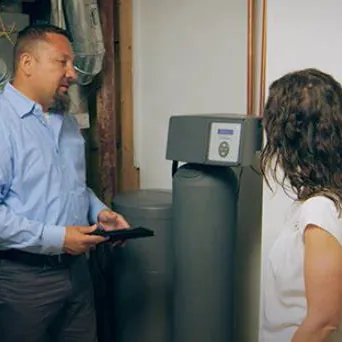
Filtering very hard Las Vegas water
Hardness is the other half of the picture here: about 280 parts per million, or 16 grains per gallon, by the Las Vegas Valley Water District's figures. That affects filtration in two ways. Scale shortens the life of a reverse osmosis membrane, so a membrane fed softened water generally lasts longer. And softened water has a slightly different taste that some people dislike. A softener for the house paired with reverse osmosis at the kitchen sink is a common setup here for both reasons.
Reverse osmosis sends part of the water it treats down the drain, carrying away what the membrane rejects. Since the system only supplies drinking and cooking water, the total is modest. In a valley where conservation matters, it is still worth choosing an efficient unit and repairing one that runs to the drain nonstop.
Filters only work if they are changed. Sediment and carbon cartridges typically last a few months to a year depending on use, and membranes typically last a few years. Follow the schedule supplied with your system.
How we help you choose a system
Tell us what you want to change about your water. A licensed plumber will look at where the main line enters, the space and drain available, and how many people and bathrooms the system has to serve, then recommend the simplest setup that does the job. We will also say so if a softener, not a filter, is what you actually need. We cover Las Vegas and the neighboring Clark County communities. Call 702-497-0888 or request a visit online.
Frequently asked questions
Still have a question? Call 702-497-0888.
Is Las Vegas tap water safe to drink without a filter?
Las Vegas tap water meets federal and state drinking-water standards, and the test results are published each year in your water provider's water quality report. Most people who add filtration do it for taste, chlorine odor or hardness-related problems, not because the water fails a standard. A filter is a matter of preference.
Will a water filter soften my water?
No, a standard sediment or carbon filter leaves the hardness minerals in the water. Softening takes an ion-exchange water softener. A reverse osmosis system does reduce dissolved minerals, but only at the one tap it serves, so it will not stop scale in your water heater or spots on shower glass.
How often do the filters need to be changed?
It depends on the filter type and how much water you use. Sediment and carbon cartridges typically need changing every few months to a year, a whole-house carbon tank lasts longer, and reverse osmosis membranes typically go a few years. A drop in pressure or a return of the old taste means a change is overdue.
Does reverse osmosis waste water?
Yes, some. A reverse osmosis system flushes rejected minerals to the drain while it makes filtered water, so it uses more water than it delivers. Because it only supplies drinking and cooking water, the amount is small next to showers or irrigation. A unit that runs to the drain continuously has a fault and should be repaired.
Should I get a whole-house filter or an under-sink system?
Choose by where the problem is. If you notice chlorine in the shower or sediment at several fixtures, a whole-house filter treats everything. If you only care about how drinking water and ice taste, an under-sink reverse osmosis system is the simpler choice. Many Las Vegas homes use both.
Related plumbing services
Schedule service
Tell us what is going on and we will call you back to set a time. For anything urgent, the phone is fastest.
702-497-0888- 24/7 emergency service
- 3200 Kings Way, Las Vegas, NV 89102
View in Google Maps