
Heat Pump Installation and Repair in Las Vegas, NV
A heat pump cools your home in summer and heats it in winter with one outdoor unit. We install, maintain and repair heat pumps in Las Vegas and nearby Clark County communities.
- 24/7 emergency service
- Licensed technicians
- All makes and models
One system for both heating and cooling
In summer a heat pump is an air conditioner. It absorbs heat from the air inside your home and releases it outdoors. What makes it a heat pump is a reversing valve that switches the direction of the refrigerant, so in winter the outdoor coil picks up heat from the outside air and the indoor coil releases it into the house. Even cold air holds heat that the refrigerant can collect.
Because it moves heat instead of generating it, a heat pump in mild weather typically delivers two to three units of heat for every unit of electricity it uses. Indoors there is an air handler with a coil and blower, usually fitted with electric heat strips as backup. A heat pump can also be paired with a gas furnace, an arrangement called dual fuel.
Why heat pumps suit Las Vegas winters
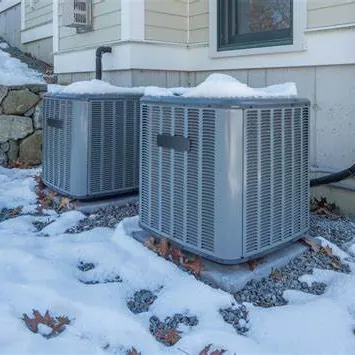
The weak point of a heat pump is deep cold: as the outdoor temperature falls, it has less heat to draw on and its output drops. That limit rarely matters here. Our winters are mild, the cold comes mostly on desert nights, and the heating load is light next to what the cooling season demands. A heat pump spends nearly all winter in the range where it works efficiently, and the backup heat has little to do.
It is a natural choice if your home has no gas service, or if your air conditioner is due for replacement anyway, since a heat pump does the same cooling job as an equivalent AC and adds heating. A home that already has a sound gas furnace may be better off keeping it; our pages on furnaces and AC installation cover those routes. Expect one difference from a furnace: the air at the registers feels warm, not hot, and the system runs in longer, gentler cycles. That is normal.
Choosing and installing a heat pump
We size a heat pump with a load calculation based on your home's square footage, insulation, windows and sun exposure. In this climate the cooling load sets the size. Then we look at three things that decide how well the new system will perform:
- Ductwork. Leaky or undersized ducts choke any new system, so we check them before quoting.
- Electrical capacity. Backup heat strips draw a lot of current, and the panel and wiring have to support them.
- Controls. A heat pump needs a thermostat set up for the reversing valve and auxiliary heat.
You will also choose between single-stage, two-stage and variable-speed equipment. Variable-speed units run longer at low output, which evens out temperatures and keeps noise down. Efficiency is rated as SEER2 for cooling and HSPF2 for heating; higher numbers mean less electricity for the same work. We can check which utility rebates are currently available for the models you are considering.
Heat pump repair and maintenance
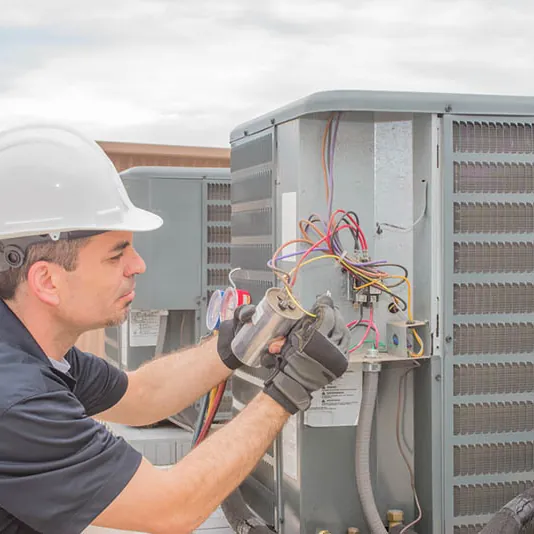
A heat pump works in both seasons, so it gets no months off and is best checked twice a year, before summer and before winter. A maintenance plan keeps those visits from slipping. Between them, check the filter monthly and keep the outdoor unit clear of leaves, weeds and windblown debris. Call for service if you notice:
- Cool air in heating mode, or warm air in cooling mode
- Ice on the outdoor unit that does not clear within an hour or two
- Aux or emergency heat showing on the thermostat most of the time
- Short cycles, a tripped breaker, or an outdoor unit that will not start
- Grinding, rattling or loud humming
- An electric bill that jumps without a change in the weather
Light frost on the outdoor coil on a cold morning is normal, and so is the defrost cycle that melts it.
What happens when you call about a heat pump
Describe what the system is doing and we will send a licensed technician to diagnose it. We service all makes and models, and emergency service runs 24/7 for the days and nights when the house has no cooling or heat. If you are considering a new heat pump, we visit the home, run the load calculation and explain the choices. Ask about financing, which is offered subject to approved credit. The number is 702-497-0888.
Frequently asked questions
Still have a question? Call 702-497-0888.
Do heat pumps work when Las Vegas nights get close to freezing?
Yes. Modern heat pumps keep heating at temperatures well below what Las Vegas normally sees, although output falls as it gets colder. On the coldest nights the backup heat strips, or the furnace in a dual fuel system, can add heat if the heat pump needs help. For most of the winter here, the heat pump carries the load by itself.
Is a heat pump the same as an air conditioner?
In cooling mode, effectively yes. The components and the cooling process are the same, and a heat pump cools as well as an air conditioner of equal size and efficiency rating. The difference is the reversing valve and controls that let a heat pump run the cycle backward to heat the house. An air conditioner needs a separate furnace or heater for winter.
Why is steam coming off my heat pump in winter?
That is almost always the defrost cycle, and it is normal. In heating mode the outdoor coil runs colder than the air and can frost over. The system briefly switches to cooling mode to warm the coil, the outdoor fan stops, and the melting frost rises as vapor, often with a whooshing sound. It typically lasts a few minutes. Ice that stays on the unit is a reason to call.
Should I use the emergency heat setting?
Only when the heat pump itself has failed and you are waiting for a repair. Emergency heat shuts the heat pump off and runs the backup heat alone, which for electric strips uses far more electricity for the same warmth. It is not meant for cold nights in general. The thermostat brings on auxiliary heat automatically when it is needed.
Heat pump or gas furnace: which is better for my home?
It depends on what your home already has. Without gas service, a heat pump is usually the clear choice over electric resistance heat. With an older AC and furnace both due for replacement, a heat pump or a dual fuel system is worth comparing against a like-for-like swap. Gas and electric rates, your ductwork and your electrical panel all affect the answer, so we look at the house before recommending one.
Schedule service
Tell us what is going on and we will call you back to set a time. For anything urgent, the phone is fastest.
702-497-0888- 24/7 emergency service
- 3200 Kings Way, Las Vegas, NV 89102
View in Google Maps